By: Hailey Young-Stewart
This year, Art Club has grown into something more than just a place to spend time after school. It’s become a space where students can experiment, collaborate, and start to understand what it really means to create something with purpose. Instead of focusing only on small, individual projects, the club has taken on larger ideas that involve teamwork, planning, and thinking beyond the classroom. Through a combination of long-term projects, guest artists visiting at different points in the year, and hands-on experiences, members have been able to see how art connects to both people and process.
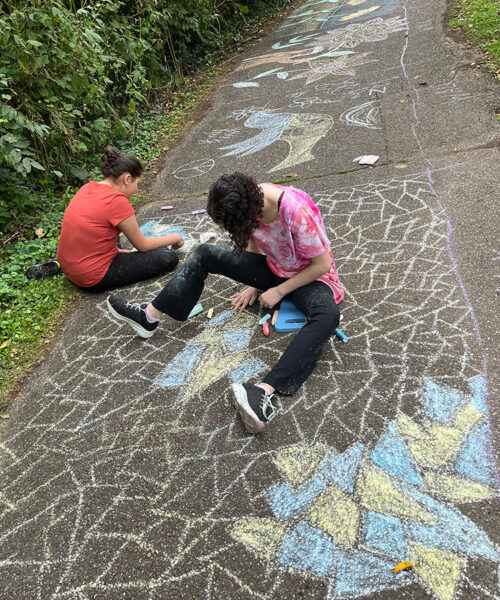
One of the biggest pr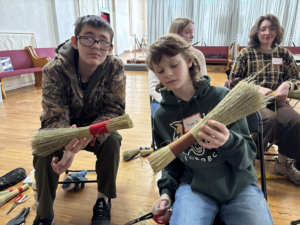 ojects the club will have is students working on a large memorial mural that will be displayed and worked on at the community center this summer. Unlike most classroom assignments, this piece is meant to be permanent and public. Because of that, the approach to creating it has been much more thoughtful and detailed. Students will be working to make the people who visit feel more welcomed while coming into the building.
Throughout the year, the club has also hosted several guest artists, each visiting at different times and bringing a unique perspective. These visits have helped show that there isn’t just one way to be an artist, and that different paths can lead to very different kinds of work.
During one visit, Talcon Quinn, a jewelry artist, talked about how her upbringing in Appalachia continues to influence what she creates. Her work often
uses natural materials and reflects a strong connection to place and environment.
“I use whatever is around me, nature, history, things people might overlook.”
She also spoke honestly about the realities of working in a creative field.
“I thought I’d just be making jewelry all day, but a lot of it was packaging, inventory, and listing products.”
At another point in the year, a broom-making craftsman Curt Cable visited and demonstrated traditional techniques that have been passed down over time. Watching the process in person made it clear how much precision and repetition are involved.
“It takes about twenty minutes now but it took years to get there.”
He also explained how he sells his work online and relies on connections to find materials, showing how even traditional crafts continue to evolve.
Later in the year, Jaime Whitlock, a screen printing artist, visited and introduced the club to the technical side of printmaking. Screen printing involves multiple steps, and each one requires careful planning and attention to detail.
“Strong contrast and clean lines make or break a print.”
They also emphasized the practical side of printmaking.
“You can take one design and turn it into something repeatable and shareable.”
In another session, Adria Jerman, a stained glass artist with over ten years of experience, talked about how her work has developed over time. She described starting with simple designs and gradually becoming more experimental.
“At first I just made simple pieces with nice color schemes. Then I started playing with shapes more and making things a little weirder.”
She also shared a turning point in her work.
“One piece changed everything. I had over a hundred orders.”
Even with that success, she emphasized the importance of keeping her work personal.
“I like that it’s a one-person process.”
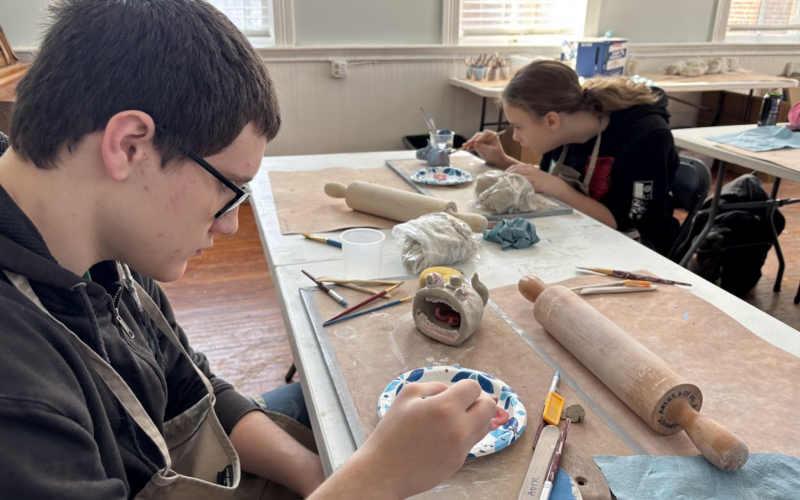
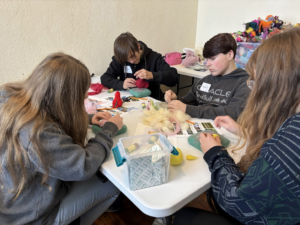
More recently, the Art Club went on a field trip where students spent the entire day focusing on one specific craft. Instead of moving between activities, each person chose a workshop and stayed with it, which allowed for a deeper level of focus and understanding.
In the weaving workshop, students learned how important it is to maintain consistent tension and pay attention to small details. At first, the process felt repetitive, but it quickly became clear that even small mistakes could affect the entire piece.
“You really have to slow down and pay attention to every detail,” said Senior Mahayla Birt.
At the same time, the repetition created a steady rhythm that made it easier to stay focused for long periods of time. Looking at the other workshops, it was clear that every craft required the same level of patience and care.
In addition to this hands-on experience, the club also visited an art museum, where the focus shifted from creating to observing. Instead of working with materials, students spent time studying finished pieces more closely, paying attention to details like composition, color, and texture. After spending so much time making their own work throughout the year, many students began to notice things they might have overlooked before.
During the visit, students also created small sketches in dedication to a teacher from Fed Hock Elementary who helped support the trip. Taking the time to draw in that setting made the experience feel more personal, turning it into more than just a visit. It became a moment of appreciation as well as observation, connecting what students were learning in the classroom to a real-world setting.
Overall, Art Club this year has been about more than just making art. It’s been about learning how much time, effort, and thought go into creating something meaningful. Through larger projects, individual guest artists, and experiences like the field trip, members have started to see art in a different way not just as something you make, but as something that connects people, ideas, and experiences beyond the classroom.